


Some Common Issues that may arise on a Hydraulic Dredging Project Include:
1.) Clogging: The dredge’s suction hose or other components may become clogged if the dredged material contains too many solids or needs to be correctly sized for the project. This can reduce the efficiency of the dredge and may require frequent maintenance or repairs.
2.) Cavitation: Cavitation occurs when the dredge’s suction becomes too low, causing air bubbles in the slurry. These bubbles can collapse and create high-pressure areas that can damage the dredge’s impeller and other components.
Dredging Highlight Video
3.) Wear and tear: Hydraulic dredges are designed to handle abrasive and corrosive materials, but constant exposure can cause wear and tear on the dredge’s components over time. This can reduce the efficiency of the dredge and may require frequent maintenance or repairs.
4.) Power failures: If the hydraulic power supply for the dredge fails, the dredge will stop working. Problems with the hydraulic pumps, hoses, or other components can cause this.
5.) Environmental concerns: Dredging projects can potentially negatively impact the environment, such as disrupting aquatic habitats or releasing pollutants into the water. Careful planning and mitigation measures can help minimize these impacts.
To minimize these issues, it is essential to appropriately size and maintain the hydraulic dredge and to use it within its recommended operating parameters. Regular inspection and maintenance can help identify and address potential issues before they become significant problems.
Choosing the Correct Hydraulic Dredge
Some questions that you may want to answer include the following:
1.) What is the nature of the material that needs to be dredged? Different dredges are designed to handle various materials, such as sand, clay, silt, or rock. Determining the nature of the material can help you choose a dredge with the appropriate capabilities.
2.) What is the depth and width of the area that needs to be dredged? The size of the dredge you need will depend on the size of the area that needs to be dredged. Larger dredges may be more expensive, but they can also be more efficient if you have a large area to dredge.
3.) What is the distance the dredged material needs to be transported? The distance the dredged material needs to be hauled will affect the size and power of the dredge you need. Longer lengths may require a larger or more powerful dredge to ensure the material can be transported efficiently.
4.) Power failures: If the hydraulic power supply for the dredge fails, the dredge will stop working. Problems with the hydraulic pumps, hoses, or other components can cause this.
5.) Environmental concerns: Dredging projects can potentially negatively impact the environment, such as disrupting aquatic habitats or releasing pollutants into the water. Careful planning and mitigation measures can help minimize these impacts.
To minimize these issues, it is essential to appropriately size and maintain the hydraulic dredge and to use it within its recommended operating parameters. Regular inspection and maintenance can help identify and address potential issues before they become significant problems.
Call for sales or support
If you need assistance with pump selection, sales or engineering support, call 619-404-1916.


Dredge Project Consulting
- Easier to install and maintain, the horizontal slurry pump, a type of dredge pump, allows for quick access to pump components, making repair jobs straightforward. During repair jobs, pumps are completely disassembled for thorough inspection. All components are carefully inspected, and any parts not meeting standards are replaced. After reassembly, the pump is tested to ensure reliable performance. These steps help extend the service life of the hydraulic pump and maintain equipment reliability. EDDY Pump can also provide dredging project managers to oversee sediment projects and remediation projects, ensuring that all aspects of the dredging project are managed efficiently and in compliance with environmental regulations.
- Requires more room, due to its larger footprint compared to vertical
- Implementing best management practices and evaluating management alternatives are essential for effective material management in any dredging project.

Vertical Slurry Pump
-
Less smaller footprint, allowing the dredge pump to be implemented in hard to reach jobs
-
More versatile, can be cable hung straight down and inserted directly into medium to pump target material. The vertical slurry pump can also be used in mechanical dredging operations where minimal water addition is required.
-
The vertical slurry pump is typically situated within the excavator or dredging system so that it is optimally positioned for efficient material handling and performance.
-
More difficult to repair and tougher maintenance
Extended Pumping Reach
The Excavator Dredge Pump Attachment
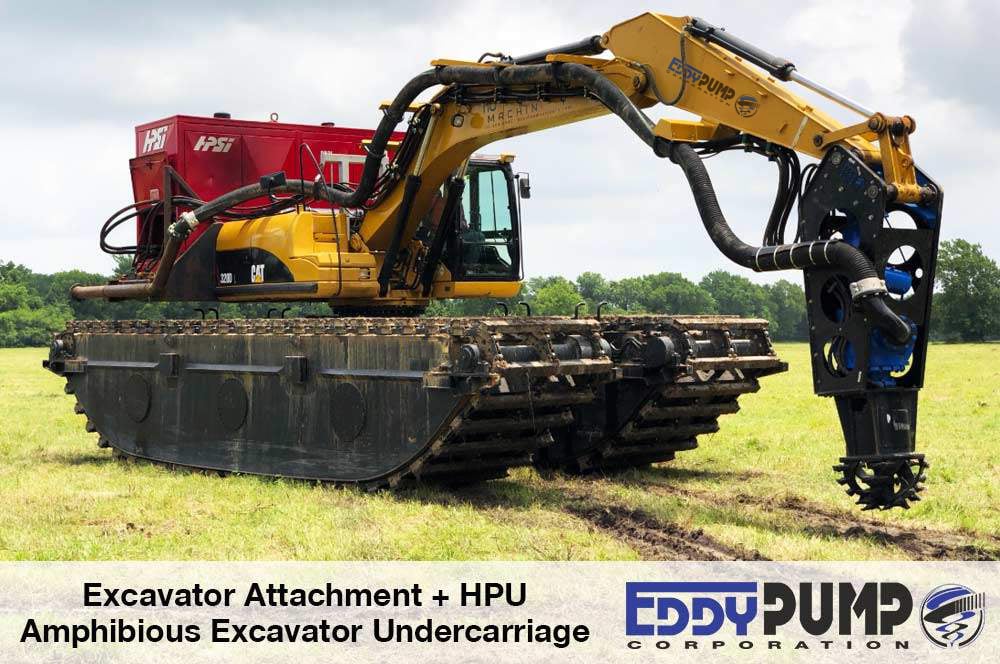
The EDDY Pump Excavator Dredge Attachment easily pins into your existing bucket linkage and is powered off of the excavators’ auxiliary hydraulics or a separate HPU. By using a cutterhead or high-pressure water jetting rings (depending on the dredging application), the patented EDDY Pump technology outperforms all centrifugal pumps in a variety of the most difficult dredging applications. The pump and cutterhead suction dredge work in conjunction to make this the optimal dredging system for handling compact material, highly viscous materials, and for pumping a high volume solids. The excavator pump attachment can easily pump slurries up to 4,500-feet without the need for a booster pump. For larger pump models and pumping distances of more than 2,000-feet, an HPU (Hydraulic Power Unit) is recommended for optimal production rates. All EDDY Pump suction dredges and excavator cutterheads are powered by our field-proven, U.S.A.-built, industrial slurry pumps.
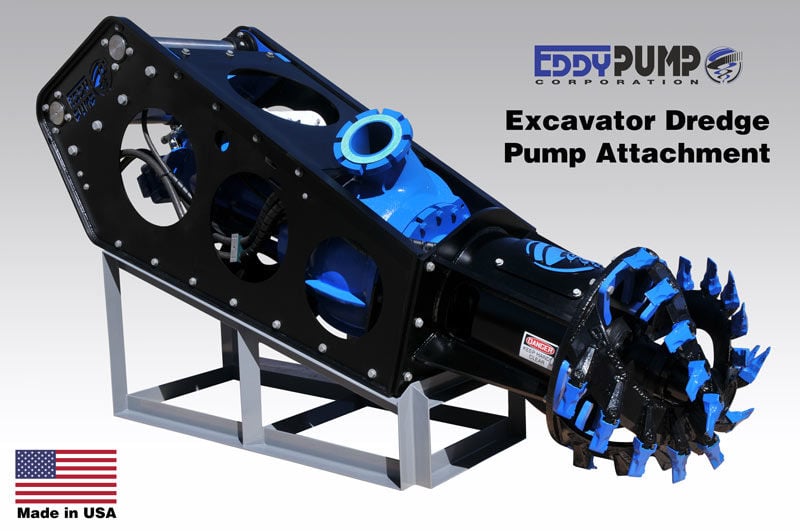
Any excavator operator can be trained to operate the pump in just a couple of hours. In addition, this unit is completely modular and can be converted into a cable hung dredge or a diver operated dredge with little modification necessary.
Flexible Dredging Solution
Cable-Deployed Dredge Pump
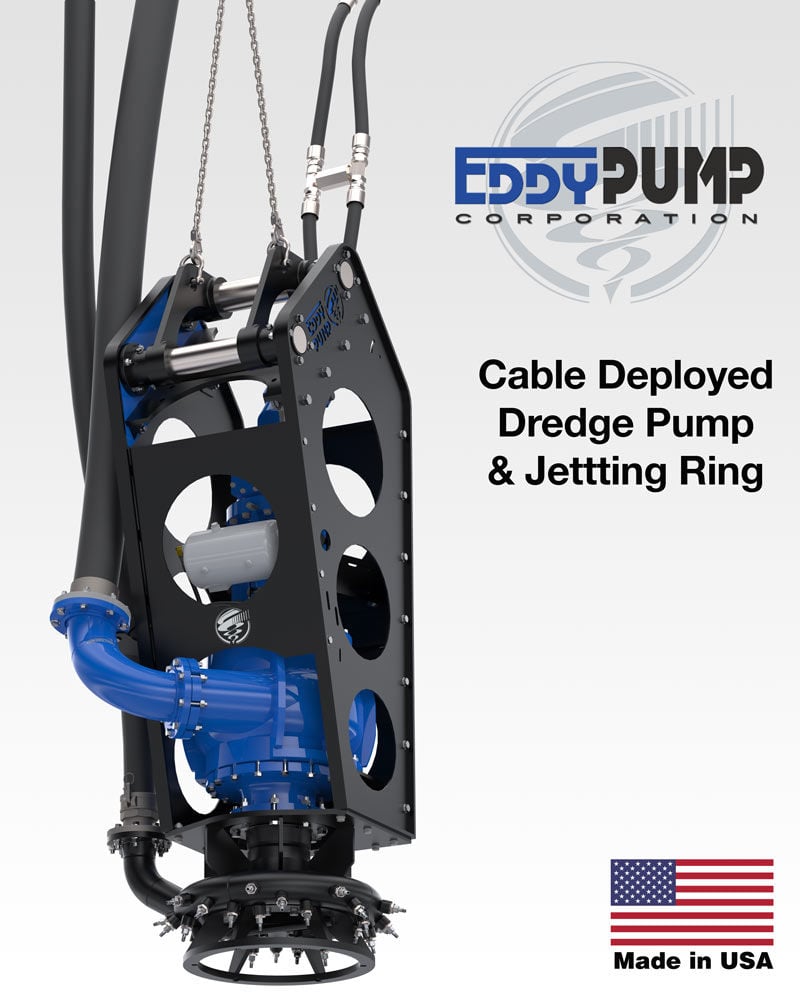
For mining or construction operations where a crane is already available on site, the EDDY Pump Cable-Deployed Pump can be an ideal solution. Like many of our dredges, this cable deployed pump system comes with an optional water jetting material agitation system to fully optimize production rates. The cable-deployed pump can have an electric or hydraulic power system to meet the needs of the end-user.
The pump can be mounted off a cable, hanging off a crane and the water jetting ring is attached to the pump. It can be dropped onto the seabed as a diver operated unit and also be pinned to an excavator to become the Excavator Pump Attachment.
Dredge Manufacturer EDDY Pump
Diver Operated Dredge Pump
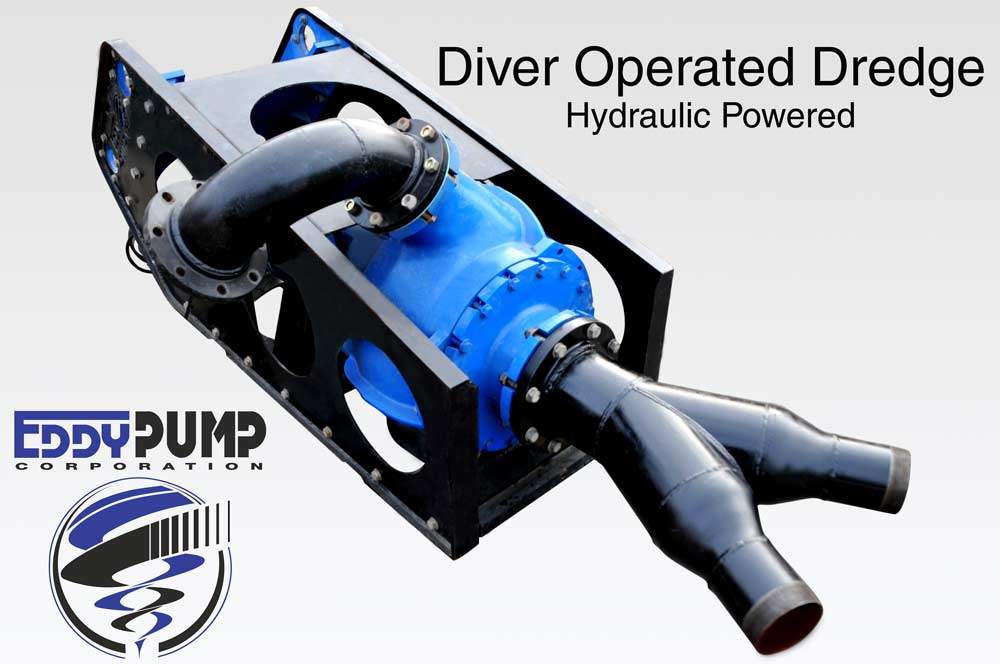
For ultra-precision dredging which requires diver visibility and mobility, we offer the Diver Operated Dredge Pump. This unit is completely submerged and rests on the lake bed or ocean floor and can support up to 1-3 divers at once. These diver units can be powered via electric or hydraulic depending on our client’s needs.
Our diver dredge comes equipped with over 300-ft of a suction hose that can be added to the suction inlet of the pump, providing increased versatility not commonly found in conventional diver operated dredges. This also allows for far more mobility, allowing for divers to dredge in precise locations without disrupting the pipeline. Additionally, this unit can be easily converted to a Cable-Deployed Dredge or an Excavator Pump Attachment with little modification.

Essential Eco-Dredging Solutions
Environmental Dredging and Remediation
Environmental dredging generally refers to remediation dredging or removing contaminated materials from specific underwater areas. Environmental dredges are built to be as precise as possible with extremely low turbidity to prevent material agitation of the surrounding ecosystem. A low turbidity dredge will greatly help keep the contaminated material from resuspension, which would allow the dangerous material to spread over a wider area, making things worse. Environmental dredges are typically equipped with video cameras, GPS, RTK for precise positioning, and/or sonar monitoring instruments to oversee the entire dredging process. This allows the process to be much more controlled over a navigational or construction dredging, ensuring the contaminated material is captured as safely as possible.
Eco-Friendly Dredging Technology
Maintenance Dredging
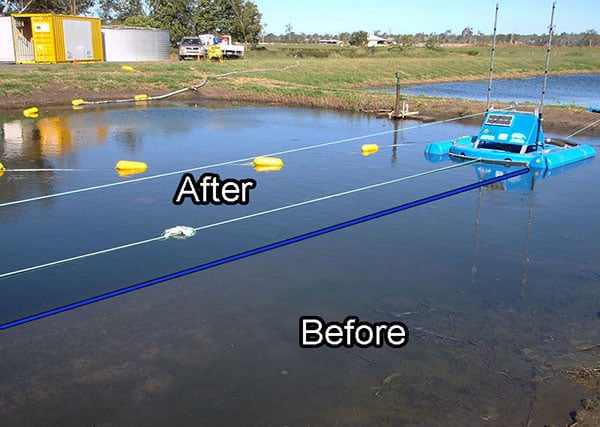
Similar to other industrial processes, regular maintenance is required to keep the dredging system functional and free of any issues. Maintenance dredging is used to deepen or maintain navigable waterways or channels that have become silted. These waterways can become too shallow to navigate if sediment is left unmanaged. Lagoons and settling tanks are notorious for rapid sedimentation buildup, which needs to be removed on an annual basis to avoid reduced holding capacity, gunk/odor buildup and murky water.
Youtube not loading? Try our alternate video player
How The Pump Works
EDDY Pump vs Other Pumps
This video shows how EDDY Pump transports high slurry and abrasive materials. Featured dredge pump equipment includes the Remote Operated Subdredge, Diver Operated Pump and a Excavator Attachment Dredge Pump.
The Best Non-Clog and High Solids Slurry Pump on the Market. Since 1984.
We manufacture both pump and dredge equipment for maximum compatibility


Call for sales or support
If you need assistance with pump selection, sales or engineering support, call 619-404-1916.
HD (Heavy Duty) Slurry Pumps / Dredge Equipment
Related Products
For assistance Call 619-404-1916 and let us help match your project
with the right pump.