

Slurry pumps
Sand and Gravel Slurry Pump Applications
- Construction: Gravel is often used in the construction of roads, bridges, buildings, and other infrastructure projects. Pumping gravel allows the material to be moved quickly and efficiently to the work site, reducing labor costs and increasing productivity.
- Dredging: Gravel and sand are commonly used in dredging operations to help maintain waterways and harbors. Dredging is the process of removing sediment and debris from the bottom of a body of water.
- Mining: Gravel is often used in the mining industry as a component of the materials used to construct access roads, haul roads, and processing facilities.
- Flood Control: Gravel is often used as a component of flood control systems to help protect against erosion and to slow the flow of water.
- Environmental Remediation: Gravel is used in various environmental remediation projects such as stormwater management, wetland and stream restoration, or oil spill cleanup.
- Marine Works: Gravel is frequently used in marine works such as the construction of breakwaters, jetties, and foundations of offshore structures. Pumping gravel allows the material to be placed quickly and efficiently in these applications
- Transporting Sand, Gravel, Chat, and Aggregate*
- Sumps
*Fluid Required – Seems obvious, but our pumps do NOT pump dry sand. No pumps do.
What Are the Problems With Pumping Sand and Gravel?
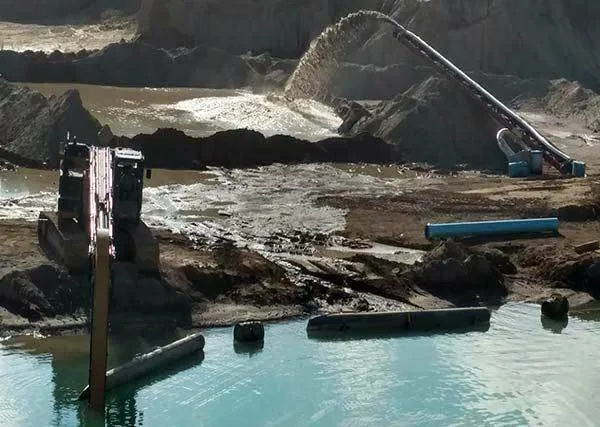
Sand and gravel aggregate pits are usually dredged using draglines or excavators to mechanically dig up the sand or gravel, then place it into large piles to await transport and processing. The sand and aggregate are then loaded into large dump trucks and driven to the processing plant. This is a very costly and time-consuming process that incorporates very costly equipment and manpower.
EDDY Pump has developed various ways to avoid all these headaches and instead pump the sand and aggregate directly from the pit into the processing plant. This can potentially save the plant millions of dollars a year.
Pumping sand and gravel can be a challenging task because these materials are typically abrasive and dense, which can become suspended in the fluid being pumped, which can cause blockages and clogs in the pump and pipelines. This can lead to reduced efficiency and increased downtime for maintenance and repairs.
Another problem with pumping sand and gravel is that it can be difficult to maintain a consistent flow rate. These materials can settle out of suspension and clog pipelines, which can restrict flow and cause pressure changes in the pump. This can lead to uneven and unpredictable pumping, which can make it difficult to achieve desired flow rates.
Also, Some sand and gravel pumps are not suited for the heavy-duty work that is needed for this application and these pumps may wear down prematurely or have reduced pump efficiency.
Additionally, sand and gravel can be highly corrosive, which can cause damage to the pump and other equipment over time. This can increase the frequency of repairs and maintenance, and ultimately reduce the lifespan of the equipment.
Finally, environmentally, if the process is not managed properly, it can cause negative impact on environment, such as damage to natural habitats, and also the sedimentation of nearby bodies of water.
The EDDY Pump’s unique design allows sand and gravel mines to pump the material at production rates of up to 450 cubic yards or 800 tons of material per hour. Due to the EDDY Pump design allowing it to pump higher solids content, the processing plants will be dealing with significantly less water. On average the EDDY Pump will handle about 40-70% solids by volume. The EDDY Pump’s open rotor design also allows the pump to pump rocks up to 9-inch in diameter without clogging. For operations where the plants prefer to screen down the aggregate size, classifiers can also be added at the front of the pump eliminating oversized rocks.
The best EDDY Pump dredges for the sand and gravel mining industry are the Excavator Pump Attachment, Remote-Operate Dredge, and Cable Deployed Dredge Pump.
Sumps in the sand and gravel industry play a crucial component in collecting all the sand, chat, rocks, and debris that are cast out during the processing. All these rocks, debris and abrasive material cause constant issues for centrifugal sump pumps. This means constant downtime and costly repairs. These abrasive sands quickly wear out the impellers of the pumps, in addition to the and the rocks and debris clogging the low tolerance centrifugal pumps.
The EDDY Pump is the ideal solution for these sand and gravel sumps and can be deployed electrically, hydraulically or self-priming. The EDDY Pump will not wear out like the conventional centrifugal sumps pumps and will also not clog like the other sump pumps. All of these attributes about the EDDY Pump Sump pump mean a lot less down time and costly repairs like centrifugal sump pumps.
EDDY Pump Sand & Gravel Pumping Equipment
- Sand and Aggregate Pits: Excavator Pump Attachment, Autonomous ModDredge, Cable Deployed Pump
- Sumps: Submersible, Self-Priming Pump
The EDDY Pump can be deployed in various dredge configurations to optimize cleanup of tailings ponds and rivers. Some of the ideal deployments for fly ash tailings ponds are Excavator Pump Attachments, Liner-Safe Dredges, Cable-Deployed Pumps, Autonomous Dredges, Spud-Dredges, and the Subdredge.

Excavator Dredge Pump Attachment
The EDDY Pump Excavator Dredge Pump Attachment is one of our most popular units. Highly versatile.
The Eddy Pump Excavator Attachment is a tool that is specifically designed to pump sand and gravel effectively and efficiently.
The Eddy Excavator Attachment can handle large particles without causing damage to the equipment, which allows it to pump a wide range of materials, including sand, gravel, mud, and sludge long distances.
Autonomous ModDredge
For very large sand and gravel pits, the EDDY Pump Autonomous ModDredge could be the best solution.
This Autonomous ModDredge will minimize manpower and run around the clock.
The EDDY Pump Autonomous ModDredge is an automated floating platform that runs continuously without the need for an operator.
The EDDY Pump is deployed from an A-frame mounted on the floats. The Autonomous ModDredge can be powered electrically or hydraulically.


Cable-Deployed Dredge Pump
For mining operations where a crane is already available on a sand and gravel mine site, the EDDY Pump Cable-Deployed Pump can be ideal.
This cable-deployed pump system comes with an attachable water jetting system to optimize production by breaking up compacted solids.
The cable-deployed pump can have an electric or hydraulic power system to meet the needs of the mine.
The pump mounts off a cable, hanging off the crane and the water jetting ring is attached to the pump. It can also be pinned to an excavator.
Sump Pumps for Sand, Gravel, and Custom Applications
The EDDY Pump Sump Pump can be configured and powered in multiple ways to meet the needs of the sand and gravel pit.
It can be powered either electrically, hydraulically, or self-priming. For use in submersible, immersible, or dry-run applications.
The non-clogging high-tolerance EDDY Pump sump design makes it ideal for reducing all downtime and costly spare parts.
Custom pumps are our specialty.

Sand and Gravel Pumps for Pit-to-Plant Aggregate Transfer
Sand and gravel pumps transport aggregate in a liquid slurry from the extraction point to a receiving or processing area. At a wet pit, that can create a direct connection between material recovery and plant feed. Whether the arrangement makes commercial sense depends on the deposit, the route to the plant, and the amount of usable aggregate delivered. The first question is how the entire production system will handle the material, including its water content.
Size the Pumping System for the Actual Aggregate
A sand deposit with occasional gravel requires a different assessment from a coarse, mixed aggregate face. Establish the particle-size distribution and the largest expected pieces before selecting the intake, pump, hose, and receiving equipment. Oversize material needs a defined handling route rather than an assumption that it will pass.
Abrasive sand pumping also calls for attention to wear components and maintenance access. Examine the full flow path, including bends and connections. Where the deposit changes, review whether the original selection still matches the material being recovered instead of simply increasing speed when production falls.
Coordinate Sand Pit Dredging With Plant Feed
Sand pit dredging should produce a feed that the wash plant can use. A high delivery rate offers little benefit if screens, classifiers, or dewatering equipment cannot handle the incoming mixture. Confirm acceptable particle sizes and the plant's capacity for both solids and water before setting a production target.
EDDY Pump offers excavator-mounted, cable-deployed, and floating dredging configurations for aggregate applications. Access, pit geometry, working depth, and available site equipment help determine the practical choice. Plan how the intake will follow the deposit and how the discharge line will move as the extraction area advances.

Maintain Consistent Gravel Slurry Transport
Aggregate slurry pumping needs a workable balance between solids loading and transport conditions. Too little liquid can make the mixture difficult to feed or move. Excessive dilution increases the volume sent to the plant without necessarily increasing recovered aggregate. The appropriate balance depends on the material and the pumping system.
Gravel slurry transport also needs a planned response to interruptions. Coarse particles can settle when flow stops, so shutdown and restart procedures should be agreed during system design. Include a suitable flushing arrangement where required and confirm how the site will collect or manage flushing discharge.
Compare Production Methods Using Delivered Aggregate
Evaluate a pumping arrangement against the existing excavation and haulage process using the same production boundary. Count material delivered to the plant, operating labor, power, water handling, maintenance, and downtime. Avoid comparing a pump's peak flow with a truck system's average daily output.
For aggregate recovery, saleable output is often more useful than total slurry volume. Record operating hours and material quality alongside delivered tonnage to identify where production is being lost. Send EDDY Pump your grading data, target sand wash plant feed, pit layout, and discharge route. Add any known oversize or clay layers so the proposed sand and gravel pumping system reflects the deposit you expect to work.

Sand and Gravel Pumping FAQs
Can sand and gravel pumps move dry aggregate?
These pumps require a liquid carrier and are intended for slurry service. Dry aggregate needs another handling method or a system that first creates a pumpable mixture. The required liquid content depends on the material and the proposed pumping duty.
How large can the gravel be?
The allowable size depends on the selected model and the restrictions throughout the system. Check the intake, pump passage, hoses, valves, and receiving equipment. Use measured grading data and an oversize-management plan rather than applying one particle-size limit to every pump.
Can aggregate be pumped directly from a pit to a wash plant?
Yes, where the deposit, pumping route, and plant are suitable. The plant must accept the delivered particle sizes, solids rate, and water flow. Evaluate the intake and processing equipment together so direct pumping does not overload the receiving system.
What is the difference between slurry flow and aggregate production?
Slurry flow includes the carrier liquid as well as the solids. Aggregate production measures the recovered material, often by mass over time. Two systems with equal slurry flow can deliver different amounts of usable aggregate if their solids concentrations differ.
What causes a sand or gravel pipeline to plug?
Possible causes include settled material after a stoppage, unsuitable transport velocity, oversize particles, or an inconsistent feed. Investigate the deposit, operating history, and pipeline layout together. A larger motor alone will not correct every blockage mechanism.
What information is needed to quote a sand and gravel pumping system?
Provide particle grading, maximum stone size, material density, expected clay content, and the required aggregate output. Include the pit depth, pipe route, elevation changes, power supply, and wash plant limits. Note how often the extraction point will move.
LET’S PUT YOUR PROJECT IN MOTION
Tough material?
Bring it to EDDY.
Tell us what you’re pumping, where it needs to go, and what your
operation needs to achieve.
Talk it through
with our team.
Equipment selection, project planning, or an existing pump—we’ll help you find the right next step.
CALL SALES & ENGINEERING
+1 619-404-1916
EMAIL YOUR PROJECT DETAILS
info@eddypump.com