




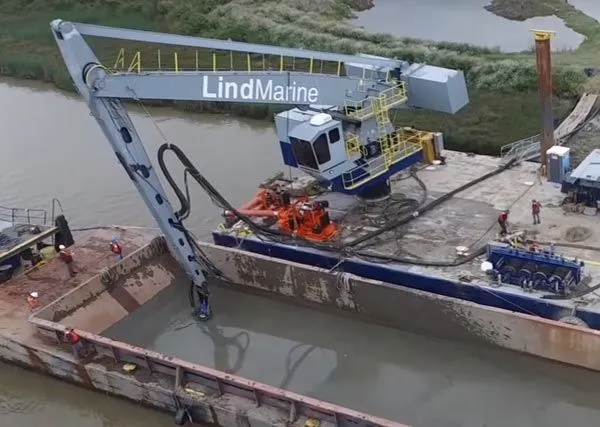
Common Barge Pump Applications:
- Dredged Material Pumping
- Petroleum Distillates
- Chemical or Brine Removal
- Fertilizers, Oils, Molasses
- Sludge or Slurry Remediation
EDDY Pump Advantage
Problems With Barge Material Movement
Some types of slurry and abrasive materials wreak havoc on a regular pump. Centrifugal pumps quickly get worn down and lose their tolerances and suction capabilities. This results in significant downtime and costly spare parts. This is not the case with the EDDY Pump, it can take the abuse of abrasive materials because of its sunken rotor design. The eddy current of the pump whips material right past the rotor with minimal wear. With certain environmental laws, it’s becoming more common for end clients to use an EDDY Pump with an excavator attachment instead of a mechanical loader. Many times this is because the ultra low turbidity and sediment is not kicked up the way a bucket would be. It’s also important to select the right Equipment Options For the Job:
- Barge Unloading and Loading: Excavator Dredge Pump Attachment, Cable Deployed Pump
- River Cleanups: Excavator Pump Attachment
- Bottom Remediation: Excavator Pump Attachment
EDDY Pump Dredge Equipment
The EDDY Pump can be deployed in various dredge configurations to optimize the loading or unloading of a barge. Some of the ideal deployments for offloading are the Excavator Pump Attachments, and Cable-Deployed Pumps. This is dependent on the job site and applicable setup (crane, fixed boom arm, excavator, etc).
Excavator Dredge Pump
Excavator Dredge Pump Attachment
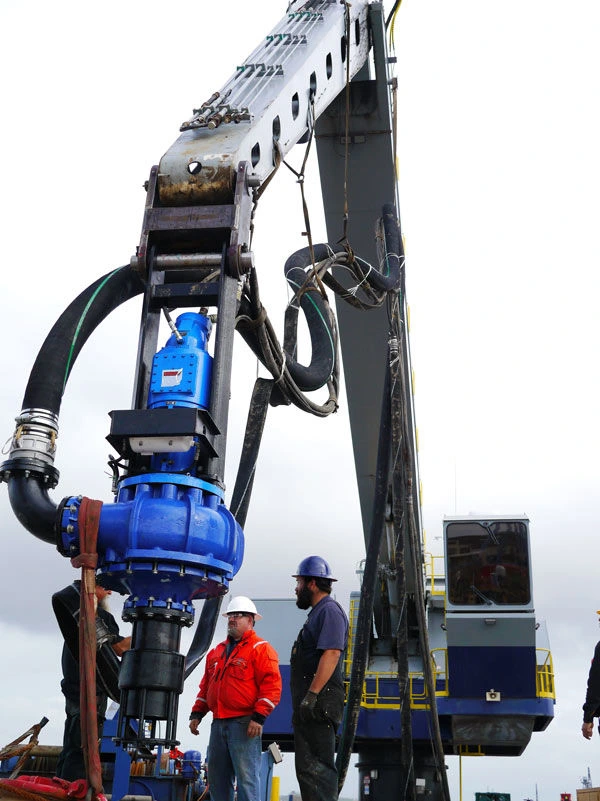
The EDDY Pump Excavator Dredge Pump Attachment is one of our most popular units. It allows any power generation or contracting company with little or no experience in dredging to easily convert one of their existing excavators or a rental into a hydraulic dredger. An excavator operator can then easily learn to operate the Excavator Pump Attachment with only a few hours of training. The Excavator Pump gets pinned to the end of the excavator boom and can either be used with a cutterhead or a liner safe rolling attachment.

The liner-safe wheels allow the pump to easily glide over the liner without having any negative effect, while still removing all the fly ash. Slurry hose is then connected to the pump and run along the boom of the excavator over the back of the excavator and connected into pipeline. The pump can move material at rates of up to 400 cubic yards over distances of over a mile, at solids rates of 40-70%. This is all done creating little to no contaminant resuspension or detectable turbidity. This is the most environmentally friendly dredge on the market. Please click here to see more about proper pump and excavator size for your application: Excavator Dredge Pump Attachment Info
Cable-Deployed Dredge System
Cable-Deployed Pump
The EDDY Pump Cable-Deployed Pump with water jetting system is ideal for projects where a crane is available. The EDDY Pump can be run electrically or hydraulically and suspended from the crane on a cable. The water-jetting system breaks up the material and feeds the EDDY Pump. Cable Deployed Dredge info Here
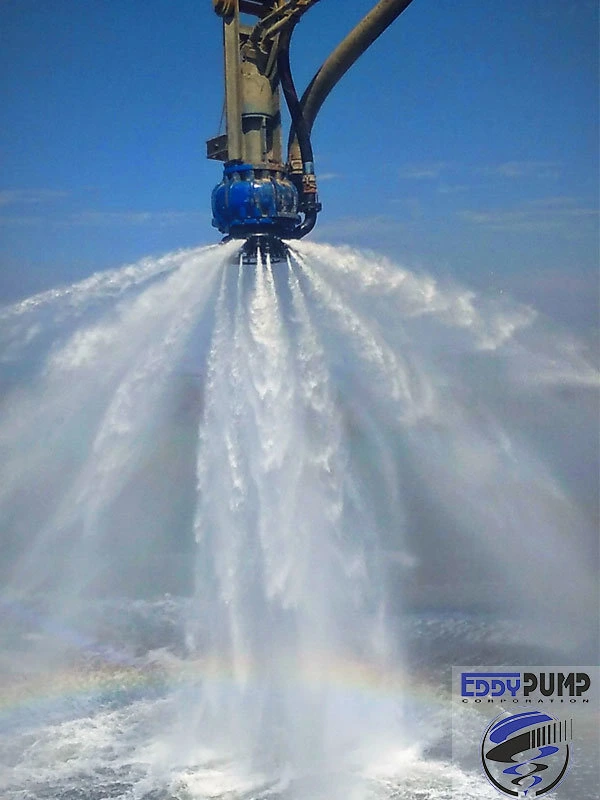
The following water jetting ring can be attached to a 6-inch through 10-inch dredge pumps. This unit was designed and fabricated by EDDY Pump. There are 28 jet nozzles that can be capped or left open to best address the needs of your project. Shoot water straight down to break up material, or at an angle to clean a barge during unloading.
Attache to an EDDY Pump or purchase as a stand-alone unit. Call us for details.

The jetting ring pictured has been replaced with the improved version below. They attach the same way.
Water Jetting Ring Dredge Attachment
“New Water Jet Jetting Ring” Used to help fluidize and break up material. Adjust jets to as many or few as needed. Also adjust direction to match your application.
This ring can attach to a hanging unit deployed off a platform, in an A-frame setup. It can also be attached to an excavator attachment for use instead of a cutter head. The customer feedback has been great. Call for details.
Barge Material Pumping
Applications: Rail Car and Barge Slurry Transport
The purpose of this page is to identify your application and learn more about an equipment solution to meet your needs. These are the most common barge transport applications that we work with. We are the OEM for the tools shown.
Application: Transport and pump material out of or into barges and rail cars.
Material: Slurry, wet grains, bottom material from environmental cleanup or any material with a wet format. This barge unloading dredger is Not for dry material transport.

Barge Unloading Dredger
Common Unload Scenario:
The EDDY Pump Excavator Attachment is ideal for pumping slurry from barges, rail cars, pits, lined ponds or other bodies used for material storage.
By attaching the EDDY Pump to a standard boom or long boom excavator you can get reach of up to 75-ft and handle the most difficult applications. The EDDY Pump allows you to pump the fly ash at distances over 2-miles at production rates of up to 600 tons of ash per hour or 5000 GPM.
Optional upgrade: Add liner-safe rollers, as it also gives you the ability to dredge on concrete lined sumps or poly-lined reservoirs without disturbing the liner.
Below are common pumping distances we see, along with a pump curve to match the details. Contact us with your exact numbers.
Distance: 2500 ft
Vertical Rise: 30 ft
Production: 1414 GPM
Equipment Used: EDDY Pump 6 Inch Excavator Attachment. Cutter Head OR Roller Wheel setup.
Excavator Type: CAT 320 or larger (or equivalent model excavator)
Optional HPU: Excavator powered attachment OR a separate Hydraulic Power Unit (HPU) will power the pump attachment. The ideal option is based on your project requirements.
Barge Unloading Projects
Barge Pumping Photos
Photos of recent barge unloading pumping projects. With the water jetting ring a dry material can be liquidized or broken up for pumping. A new jetting ring will be introduced in 2018 to add another option for projects.


Barge unloading pumps for transferring slurry from hold to shore
Barge unloading pumps transfer pumpable cargo from a vessel's hold to an onshore receiving point. For dredged sediment and other slurry cargoes, the unloading system connects marine transport with treatment, storage, or processing on land. Its performance depends on more than the pump's nominal flow. The cargo must reach the intake, the shore pipeline must carry the mixture, and the receiving operation must keep pace until the final deposits are removed.
Define the cargo and the unloading endpoint
Dredged material offloading may involve loose sediment, dense settled layers, or a mixture containing coarse debris. Conditions can change during the voyage and again as the hold empties. Use cargo samples and loading records to establish what the unloading equipment will encounter. Specify the largest particles and any foreign material that needs separate handling.
Also define what counts as an unloaded barge. Bulk removal and cargo hold cleanout are different stages of the job. If a residual layer must be removed before the vessel is released, include that work in the proposed cycle. Otherwise, a fast bulk transfer rate can hide a long finishing period that still occupies the berth.
Choose a deployment that can reach the hold
Hydraulic barge unloading needs an intake that can reach the working areas without repeatedly stopping to reposition equipment. An excavator-mounted pump can suit accessible holds where the machine's reach and operating arrangement are appropriate. A cable-deployed pump provides another option where a crane or fixed lifting system can position the unit.
EDDY Pump offers both types of deployment. Compare them against the hold dimensions, obstructions, berth layout, and available equipment. Consider how the pump and hose will move between areas as cargo is removed. The vessel's unloading sequence and stability requirements should be established by the responsible marine personnel and incorporated into the equipment plan.
Allow for changes as the cargo level falls
Sediment barge unloading rarely presents the same intake conditions from beginning to end. The upper material may be easy to feed, while deposits near the bottom or around structural members need more deliberate positioning. Decide how those areas will be reached before equipment arrives.
Where agitation or added water is needed, assess its effect on the entire operation. It can help create a pumpable feed, but it also adds volume for the shore facility to receive. Agree on the approach to material conditioning and final cleanout, including the destination of residual wash water. The aim is a repeatable unloading sequence rather than an improvised response when the easy material has gone.
Check the full shore transfer pipeline
A shore transfer pipeline must be sized around the slurry and the required delivery rate. Include its actual internal diameter, length, elevation changes, fittings, and receiving pressure in the assessment. The distance between the barge and the facility is only one part of the duty.
Account for hose routing at the vessel interface, where changing levels and equipment movement affect the arrangement. Identify connection points, inspection access, and how the line will be managed between vessels. For barge slurry transfer over a demanding route, assess the complete system before deciding whether booster pumping is needed. A larger discharge hose or additional pump should follow the calculation, not substitute for it.
Coordinate unloading with the receiving facility
The shore facility sets a practical ceiling on sustained unloading. A settlement area may accept only a certain inflow, while a treatment plant may need a controlled feed concentration. Establish these limits and decide how operators will communicate when receiving conditions change.
Plan for normal interruptions as well as steady operation. If receiving equipment stops, the unloading team needs an agreed way to stop, manage material in the line, and restart. Consider temporary holding capacity where it is part of the design. These operating details can have more influence on berth occupancy than a modest difference between quoted peak pump capacities.
Compare the complete unloading cycle
When evaluating barge unloading pumps, compare delivered solids, the total time alongside, finishing work, and delays at the receiving end. Keep the basis consistent between proposals. Pumping hours alone omit connection, repositioning, flushing, and disconnection time that still affects vessel turnaround.
Provide EDDY Pump with the cargo description, hold drawings, typical load, shore pipeline route, and available power. Add the required residual condition and the site's unloading sequence. This information supports a practical equipment assessment and a clearer production estimate. It also helps identify whether the main constraint is intake access, cargo consistency, pipeline duty, or the capacity of the facility receiving the material.
For recurring barge calls, retain a short record for each load. Note the cargo condition, time spent establishing flow, bulk unloading time, and finishing time. Record whether stoppages originated aboard the vessel, in the pipeline, or at the shore facility. Over several loads, these records show where turnaround varies and which changes deserve attention. They also help operators plan the next vessel using observed working conditions instead of a single best-case unloading run that may not represent the normal cargo or berth arrangement.
Barge Unloading FAQs
What materials can be unloaded from a barge using slurry pumps?
Pumpable mixtures such as dredged sediment, sand slurry, and certain sludges may be suitable. Review particle size, solids loading, chemistry, and feed behavior for each cargo. An application listing does not establish compatibility with every material carried by barge.
Can barge unloading pumps handle dry bulk cargo?
They require a suitable liquid mixture. Dry cargo may need a different unloading method or a separate conditioning stage. Assess whether adding liquid is acceptable to the receiving process before selecting hydraulic unloading.
What is the difference between bulk unloading and hold cleanout?
Bulk unloading removes most of the cargo. Hold cleanout deals with residual deposits in corners, low points, and around structures. Specify the required final condition so the unloading plan includes the time and equipment needed for both stages.
When is a cable-deployed pump useful for barge unloading?
It can suit holds accessible to a crane or fixed lifting arrangement that can position the pump throughout the work area. Check reach, lifting requirements, obstructions, and hose movement. Compare the arrangement with an excavator-mounted option for the same unloading sequence.
Why does unloading slow down near the end of a load?
Remaining deposits may be harder to reach or less able to feed the intake continuously. Repositioning and final cleanout can take longer than bulk removal. Include those conditions when estimating the complete cycle rather than extrapolating the initial pumping rate.
When is a booster pump needed between a barge and shore?
A booster may be needed if the required system head exceeds what the selected unloading pump can provide at the intended flow. Evaluate slurry properties, pipeline losses, elevation, and receiving pressure together. Distance alone does not determine the answer.
How should barge unloading productivity be measured?
Use delivered cargo quantity together with total unloading or berth time, clearly stating the boundary. Record setup, pumping, repositioning, finishing, and receiving delays separately. This shows whether improvements are needed in the pumping system or elsewhere in the operation.
Can a pump remove every deposit without repositioning?
Do not assume that it can. Hold geometry, settled cargo, and structural obstructions affect intake access. Review the full hold and removal sequence so residual areas have a defined cleanout method before the vessel is scheduled for release.
What information is needed to specify a barge unloading system?
Provide cargo samples, hold dimensions, load quantity, required unloading time, and the receiving facility's limits. Include pipeline details, elevation, power, and the permitted equipment arrangement. State the required condition of the hold after unloading.
LET’S PUT YOUR PROJECT IN MOTION
Tough material?
Bring it to EDDY.
Tell us what you’re pumping, where it needs to go, and what your
operation needs to achieve.
Talk it through
with our team.
Equipment selection, project planning, or an existing pump—we’ll help you find the right next step.
CALL SALES & ENGINEERING
+1 619-404-1916
EMAIL YOUR PROJECT DETAILS
info@eddypump.com