What is a Net Positive Suction Head (NPSH)?
Net Positive Suction Head (NPSH) is a fundamental parameter in fluid dynamics critical to the optimal operation of pumps in industrial and domestic systems. It measures the pressure available at a pump’s suction side to ensure smooth fluid flow without pump cavitation—a destructive phenomenon where vapor bubbles form and collapse within the pump, causing damage and reducing efficiency.

Breaking Down NPSH Terminology
Net Positive Suction Head Available (NPSHa)
This is the actual pressure available at the pump inlet. It is determined by factors such as the system design, fluid properties, and operating conditions. Calculating NPSHa is vital to ensure it exceeds the required pressure.
Net Positive Suction Head Required (NPSHr)
Defined by the pump manufacturer, NPSHr is the minimum pressure needed at the pump inlet to prevent cavitation. Ensuring that NPSHa surpasses NPSHr guarantees safe and efficient operation.

Net Suction Positive Head
A term used interchangeably with NPSH in some contexts, it broadly refers to the suction head in pumping systems.
Importance of NPSH Balance
Maintaining a balance between NPSHa and NPSHr is essential for efficient pump performance and longevity. Using a net positive suction head calculator can simplify the process and ensure accurate measurements. Learning how to calculate net positive suction head ensures operators can address system issues proactively, reducing maintenance costs and downtime.
Understanding and managing these parameters optimally ensures pump systems achieve reliable performance while avoiding cavitation damage.

Why Net Positive Suction Head (NPSH) Matters in Pump Systems
The importance of Net Positive Suction Head (NPSH) in pump systems cannot be overstated. It plays a pivotal role in ensuring efficient, reliable, and cost-effective operations by maintaining the delicate balance required for smooth fluid dynamics. Adequate NPSH ensures that pumps operate without issues like cavitation, which can compromise performance and lead to expensive repairs or downtime.
The Role of NPSH in Pump Efficiency
- Ensuring Smooth Operation: Maintaining sufficient NPSH prevents cavitation, ensuring stable flow rates and consistent pressure. This smooth operation safeguards the pump from damage and enhances system reliability.
- Optimizing Energy Consumption: When the Net Positive Suction Head Available (NPSHa) exceeds the Net Positive Suction Head Required (NPSHr), pumps perform at their peak efficiency. This minimizes energy costs by reducing unnecessary strain on the system.
Consequences of Inadequate NPSH
- Cavitation Damage: A low Net Suction Positive Head can lead to the formation of vapor bubbles within the pump. These bubbles collapse violently, causing erosion of critical components like impellers and casings. This significantly shortens the pump’s lifespan.
- Increased Maintenance Costs: Pumps experiencing cavitation often require frequent repairs or part replacements, leading to higher operational expenses.
- Energy Wastage: Cavitation disrupts fluid flow, forcing the pump to work harder to maintain performance. This inefficiency results in higher energy consumption and operational costs.
Tools to Monitor NPSH
Using a net positive suction head calculator is an effective way to ensure that your system maintains an optimal NPSH balance. Learning how to calculate net positive suction head manually or through digital tools can prevent system inefficiencies and protect your pump from avoidable damage, ensuring long-term performance and reduced maintenance costs.

Net Positive Suction Head Calculator: An Essential Tool for Pump Operators
Managing Net Positive Suction Head (NPSH) is critical for ensuring efficient and reliable pump operations. A net positive suction head calculator simplifies this process by providing an accurate and user-friendly way to determine if a pump system’s NPSHa (Net Positive Suction Head Available) is sufficient to meet the NPSHr (Net Positive Suction Head Required).
The Purpose of an NPSH Calculator
Calculating NPSH manually can be a complex task that involves multiple variables, such as atmospheric pressure, fluid vapor pressure, suction head, and friction losses. A net positive suction head calculator automates these calculations, offering quick and precise results. This makes it an invaluable tool for pump operators, especially in systems with varying conditions.

Benefits of Using an NPSH Calculator
- Accurate Calculations: A calculator eliminates the risk of manual errors that can lead to inefficient pump operation or system failures.
- Time-Saving: By automating the process, an NPSH calculator allows operators to evaluate system conditions and identify potential issues quickly.
- User-Friendly Interface: Most calculators, whether online or software-based, are designed for ease of use. Operators can input variables such as fluid type, temperature, and system parameters to receive instant results.
Types of NPSH Calculators
- Online Calculators: Accessible and ideal for quick estimates, online tools provide basic insights into a system’s NPSH balance.
- Software-Based Tools: These advanced tools integrate with pump selection and design software, offering detailed analyses and customized solutions for complex systems.
Learning how to calculate net positive suction head using these tools ensures that pump operators can maintain an optimal net suction positive head, reducing the risk of cavitation, improving system efficiency, and extending pump longevity.
How to Calculate Net Positive Suction Head Step-by-Step
Calculating NPSHa accurately is vital to ensure the pump system meets the required standards for efficient operation.
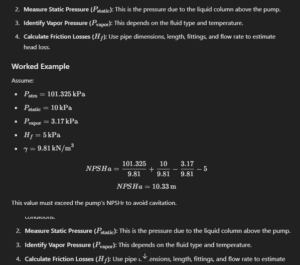
Formula for NPSHa
NPSHa=Patmγ+Pstaticγ−Pvaporγ−HfNPSHa = \frac{P_{\text{atm}}}{\gamma} + \frac{P_{\text{static}}}{\gamma} – \frac{P_{\text{vapor}}}{\gamma} – H_fNPSHa=γPatm+γPstatic−γPvapor−Hf
Where:
- PatmP_{\text{atm}}Patm: Atmospheric pressure at the installation site
- γ\gammaγ: Specific weight of the fluid
- PstaticP_{\text{static}}Pstatic: Static pressure at the suction source
- PvaporP_{\text{vapor}}Pvapor: Vapor pressure of the fluid
- HfH_fHf: Frictional losses in the suction line
Step-by-Step Guide
- Determine Atmospheric Pressure (PatmP_{\text{atm}}Patm): Obtain this value based on elevation or site conditions.
- Measure Static Pressure (PstaticP_{\text{static}}Pstatic): This is the pressure due to the liquid column above the pump.
- Identify Vapor Pressure (PvaporP_{\text{vapor}}Pvapor): This depends on the fluid type and temperature.
- Calculate Friction Losses (HfH_fHf): Use pipe dimensions, length, fittings, and flow rate to estimate head loss.
Worked Example
Assume:
- Patm=101.325 kPaP_{\text{atm}} = 101.325 \, \text{kPa}Patm=101.325kPa
- Pstatic=10 kPaP_{\text{static}} = 10 \, \text{kPa}Pstatic=10kPa
- Pvapor=3.17 kPaP_{\text{vapor}} = 3.17 \, \text{kPa}Pvapor=3.17kPa
- Hf=5 kPaH_f = 5 \, \text{kPa}Hf=5kPa
- γ=9.81 kN/m3\gamma = 9.81 \, \text{kN/m}^3γ=9.81kN/m3
NPSHa=101.3259.81+109.81−3.179.81−5NPSHa = \frac{101.325}{9.81} + \frac{10}{9.81} – \frac{3.17}{9.81} – 5NPSHa=9.81101.325+9.8110−9.813.17−5 NPSHa=10.33 mNPSHa = 10.33 \, \text{m}NPSHa=10.33m
This value must exceed the pump’s NPSHr to avoid cavitation.
Common Causes of Insufficient Net Positive Suction Head (NPSH) and How to Address Them
Insufficient Net Positive Suction Head (NPSH) is a common issue that can lead to cavitation, causing pump inefficiencies and long-term damage. Understanding the causes of low net suction positive head and applying corrective measures is essential for maintaining pump reliability and performance.
Causes of Low NPSH
High Fluid Temperatures
When the temperature of a fluid increases, its vapor pressure also rises, reducing the available NPSH (NPSHa). This is especially problematic in systems handling hot fluids, as the risk of cavitation increases significantly.
Poor Suction Line Design
Excessive suction line length, sharp bends, or restrictions can increase friction losses, resulting in lower NPSHa. Improper pipe diameter or poorly placed valves can exacerbate the problem, further reducing the net suction positive head.
Altitude Effects
At higher altitudes, atmospheric pressure decreases, which directly lowers NPSHa. This issue is particularly relevant for systems operating in mountainous regions or other high-elevation locations.
Solutions to Address Insufficient NPSH
Lower Fluid Temperature
Installing cooling mechanisms, such as heat exchangers, can reduce the fluid’s vapor pressure, thereby increasing the NPSHa. This is a critical solution for systems operating under high thermal loads.
Improve Suction Line Design
Shortening suction lines, using larger-diameter pipes, and minimizing bends and fittings can significantly reduce friction losses. A well-designed suction line optimizes fluid flow and maintains a higher NPSHa.
Add Booster Pumps
Installing a booster pump at the suction side of the system can increase the pressure at the pump inlet, effectively compensating for low NPSHa and ensuring adequate net positive suction head.
By addressing these common causes of insufficient NPSH, operators can maintain optimal system performance and prevent costly damage caused by cavitation. Utilizing a net positive suction head calculator or learning how to calculate a net positive suction head ensures precise assessments and enables proactive adjustments to improve pump efficiency and longevity. Maintaining an adequate net suction positive head is a cornerstone of reliable and efficient pump operation.
NPSH Best Practices to Avoid Pump Cavitation
Cavitation is a destructive and costly problem caused by insufficient Net Positive Suction Head (NPSH). It occurs when the net suction-positive head at the pump inlet is too low to prevent the formation of vapor bubbles. These bubbles collapse violently, damaging the pump’s internal components and reducing its efficiency. Implementing best practices to maintain adequate NPSH is essential to avoid cavitation and ensure long-term pump reliability.
Maintaining a Safe NPSH Margin
A critical strategy for avoiding cavitation is ensuring that the Net Positive Suction Head Available (NPSHa) is always higher than the Net Positive Suction Head Required (NPSHr) specified by the pump manufacturer. This margin accounts for pressure fluctuations and unexpected changes in system conditions, providing a buffer to keep the pump operating safely.
Operators can use a net positive suction head calculator to determine the NPSHa for their system and compare it against the NPSHr. Knowing how to calculate net positive suction head ensures proactive adjustments can be made when necessary, reducing the likelihood of cavitation.
Maintenance Tips to Avoid Cavitation
Inspect Suction Lines
Regularly inspect suction lines for leaks, blockages, or damage. Any issues in the suction line can increase friction losses, reducing the NPSHa and making the pump more susceptible to cavitation. Replacing worn-out pipes and fittings helps maintain a consistent net suction-positive head.
Monitor Fluid Properties
Changes in fluid properties such as temperature and viscosity can impact the NPSHa. Higher fluid temperatures increase vapor pressure, which reduces the available NPSH. Periodic monitoring of fluid characteristics ensures they align with pump design parameters, maintaining optimal performance.
Select the Right Pump
Choosing a pump with NPSHr specifications that match or are lower than the system’s NPSHa is crucial. Pumps with low NPSHr requirements are specifically designed to operate effectively in conditions with reduced suction heads.
Additional Best Practices
- Optimize Suction Line Design: Use shorter, straighter suction lines with minimal bends and fittings to reduce friction losses and maintain a higher NPSHa. Larger pipe diameters also improve fluid flow, reducing the likelihood of cavitation.
- Use Cooling Mechanisms: For systems handling hot fluids, installing heat exchangers or cooling jackets can reduce vapor pressure, increasing the NPSHa and preventing cavitation.
- Regularly Use NPSH Calculators: A net positive suction head calculator is an invaluable tool for continuously assessing the system’s NPSH balance. These calculators simplify the process, ensuring accurate measurements and enabling prompt corrective actions.
Benefits of Following Best Practices
Adhering to these best practices enhances system reliability and reduces the risk of downtime caused by cavitation-related damage. Operators who prioritize NPSH management through careful monitoring, proactive maintenance, and appropriate pump selection enjoy improved system efficiency, lower operational costs, and extended pump life.
By maintaining a safe net suction-positive head and using tools like NPSH calculators, pump operators can effectively prevent cavitation and ensure long-term operational stability.
Advanced Techniques to Optimize NPSH in Challenging Environments
Operating pumps in challenging environments, such as high-altitude regions or systems handling hot fluids, presents unique difficulties in maintaining adequate Net Positive Suction Head (NPSH). Advanced strategies are often required to optimize NPSH and prevent issues like cavitation. These solutions enhance pump performance and system reliability, even under extreme conditions.
Strategies for NPSH Optimization
Install Booster Pumps:
Booster pumps at the suction side of the system increase available pressure, effectively raising the Net Positive Suction Head Available (NPSHa). This approach is particularly useful in long suction lines or systems with significant friction losses.
Use Specialized Impellers:
Low Net Positive Suction Head Required (NPSHr) impellers are engineered to perform efficiently under lower suction pressure conditions. These are ideal for environments where achieving high NPSHa is challenging.
Pressurized Suction Tanks:
Installing pressurized tanks at the suction side stabilizes the NPSHa, especially in systems with variable fluid demand or located in high-altitude areas where atmospheric pressure is reduced.
Case Studies
High-Temperature Systems
A chemical processing plant experienced frequent cavitation due to elevated fluid temperatures increasing vapor pressure. By installing booster pumps and optimizing suction line design, the facility improved NPSHa and reduced maintenance costs by 40%, achieving smoother operations.
High-Altitude Locations
A mining facility operating at 3,000 meters above sea level struggled with reduced atmospheric pressure, lowering NPSHa. The implementation of pressurized suction tanks stabilized the net suction positive head, ensuring uninterrupted performance and preventing costly pump failures.
Conclusion
Net Positive Suction Head (NPSH) is a cornerstone of efficient pump operation. By maintaining a balance between NPSHa and NPSHr, operators can ensure their systems run smoothly, with minimized risk of cavitation and associated damages.
Final Recommendations
- Use NPSH calculators for accurate and quick assessments.
- Follow best practices, including regular maintenance and proper pump selection, to safeguard against NPSH-related issues.
- Employ advanced techniques in challenging environments to optimize NPSH.
By understanding and managing NPSH effectively, pump operators can enhance system reliability, reduce operational costs, and extend equipment life, ensuring optimal performance in all operating conditions.