



Dredge Sled – Patented Lagoon Dredging Equipment Hydraulic-Driven 4-Inch
The DSH-4000 Hydraulic-Driven 4-Inch Dredge Sled is engineered for shallow ponds, lagoons, and industrial basins where conventional dredges cannot operate efficiently. Powered by a 125 HP hydraulic power unit and fitted with a 4-inch high chrome EDDY Pump, it moves up to 1,200 GPM and handles 40–70% solids. The non-clog rotor processes abrasive slurries, sludge, fly ash, and solids up to 3 inches. Its floating sled, 300-ft traversing cable, and winch system enable controlled, low-turbidity dredging with a minimal workforce.

Operational Benefits
- High-Solids Pumping Capability – Handles 40–70% solids by volume, ideal for sludge, slurry, mine tailings, and abrasive materials.
- Non-Clog EDDY Pump Design – Passes solids up to 3 inches without clogging, reducing downtime and maintenance.
- Hydraulic Power Efficiency – Driven by a 125 HP HPU for continuous, high-torque pumping in industrial environments.
- Up to 1,200 GPM Flow Rate – Delivers high production output for rapid sediment removal.
- Floating Sled Platform – Enables dredging in shallow ponds, lagoons, and basins where traditional dredges cannot operate.
- Precision Traversing System – Includes a 300-ft cable and winch setup for controlled and consistent dredging paths.
- Low-Turbidity Operation – Maintains minimal disturbance of sediment layers, ideal for environmental and wastewater sites.
- Optional Enhancements – Available with Doppler flow meter, discharge pressure gauge, and high-pressure jetting ring for optimized control and diagnostics.
- Rugged and Corrosion-Resistant Build – High chrome pump construction enhances wear resistance in harsh, abrasive conditions.
- Reduced Manpower Requirement – Remote-operated winches and automated movement allow efficient operation with a small crew.
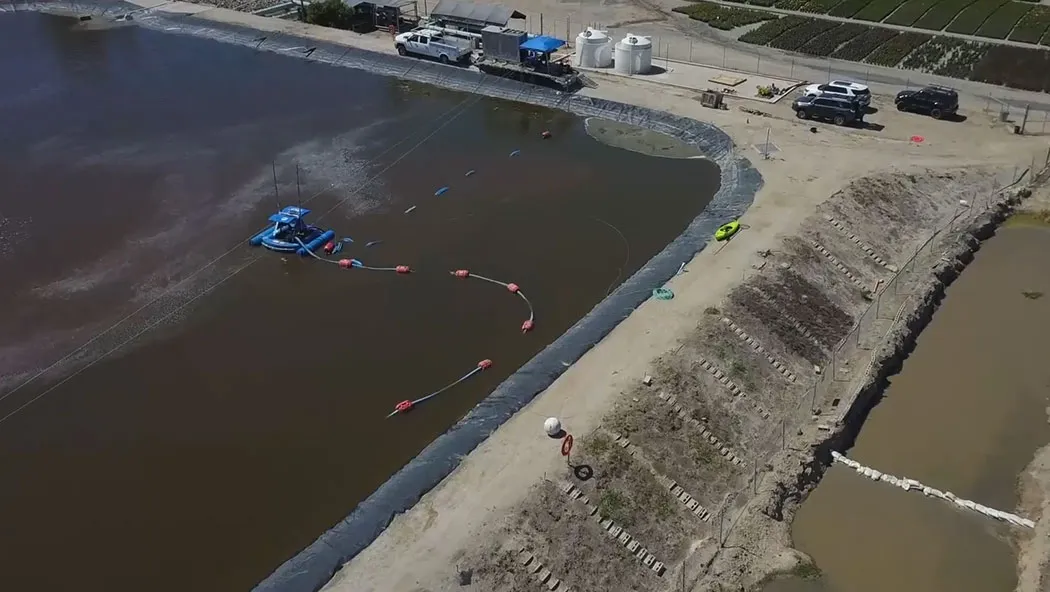
Gallery
Dredge Sled – Patented Lagoon Dredging Equipment Hydraulic-Driven 4-Inch


Technical Specifications

Performance Parameters
- Flow Rate: 250–1,200 GPM
- Production Capacity: 75–150 cubic yards of material per hour
- Maximum Head: Up to 160 ft
- Pump Speed: Up to 1,800 RPM
- Solids Handling Capability: Passes solids up to 3 inches
- Solids by Volume: Up to 40–70%
- Maximum Horsepower: 125 HP (required from HPU)

Dredge Platform Dimensions
- Standard Operating Depth Range: 0.5 to 5 m (1.6 to 16 ft)
- Max Mast Lift (Above Waterline): 5.3 m (17.4 ft)
- Length: 3 m (9.8 ft)
- Width: 3.8 m (12.5 ft)
- Height: 1.7 m (5.6 ft)
- Weight (Without Pump): Approx. 1,500 kg (3,307 lbs)

Included Equipment
- 4-inch high chrome EDDY Pump with hydraulic motor
- Floating dredge sled platform
- 300-ft traversing cable
- Solar panel charging system for the lifting winch battery
- Remote-operated 12V lifting winch
- 110V traversing land winch
- 110 VAC gas generator for land winch

Required Equipment to Operate
- 125 HP Hydraulic Power Unit (HPU)
- Hydraulic fluid lines and return hoses
- 4” Discharge pipeline to shore or containment area

Optional Equipment
- Wireless Doppler flow meter
- Discharge line pressure gauge (0–150 psi)
- High-pressure jetting ring for loosening compacted materials
- Additional extension hoses or discharge floats

PUMP CURVE
A pump curve shows the relationship between flow and head, helping you select the right setup for efficient operation. For the Dredge Sled Hydraulic Driven 4 Inch, matching the correct curve ensures smooth slurry flow, steady production, and reliable performance in dredging and sludge removal.
Hydraulic Dredge Sled
Comparison Table
| Feature | DSH-4000 (4-Inch)  | DSH-6000 (6-Inch) |
|---|---|---|
| Model | DSH-4000 | DSH-6000 |
| Pump Size | 4-inch High Chrome EDDY Pump | 6-inch High Chrome EDDY Pump |
| Hydraulic Power Unit (HPU) | 125 HP | 250 HP |
| Flow Range | 250–1,200 GPM | 450–2,000 GPM |
| Head Range | Up to 160 ft | Up to 200 ft (61 m) |
| Solids Handling | Up to 3 inches | Up to 5.5 inches |
| Percent Solids | Up to 40–70% | Up to 40–70% |
| Production Capacity | 75–150 cu yd/hr | 150–200 cu yd/hr |
| Suction Size | 6 inch | 8 inch |
| Operating Speed | Max 1800 RPM | Max 1800 RPM |
| Dimensions (L × W × H) | 3.0 m × 3.8 m × 1.7 m (9.8 ft × 12.5 ft × 5.6 ft) | 3.0 m × 3.8 m × 1.7 m (9.8 ft × 12.5 ft × 5.6 ft) |
| Weight (without pump) | 1,500 kg (3,307 lbs) | 1,953 kg (4,307 lbs) |
| Included Equipment | Floating dredge, traversing cable (300-ft), winches, solar charging system, generator | Floating dredge, traversing cable (300-ft), winches, solar charging system, generator |
| Required Equipment | 4” discharge hose & floats | 6” discharge hose & floats |
| Optional Equipment | Wireless Doppler flow meter, discharge pressure gauge, jetting ring | Wireless Doppler flow meter, discharge pressure gauge, jetting ring |
| Applications | Mining, lagoon dredging, sand & aggregate, industrial ponds, dams, coal ash | Mining, lagoon dredging, sand & aggregate, industrial ponds, dams, coal ash |
Applications Across Industries
The DSH-4000 Hydraulic Dredge Sled is specifically engineered for environments where traditional cutter or suction dredges cannot operate efficiently—shallow water, unstable banks, and high-solids material. Its ability to pump abrasive slurries and 40–70% solids makes it a preferred solution across multiple sectors.

Mining & Mineral Processing
Mining operations rely on the DSH-4000 to remove tailings, slimes, and heavy sediment from settling ponds and recovery basins without halting production. Its high chrome EDDY Pump withstands abrasive minerals, sand, and high-specific-gravity slurries. The system minimizes downtime, improves pond capacity, and supports compliant waste management.

Wastewater Treatment & Industrial Lagoons
Municipal and industrial wastewater plants use this dredge sled to continuously remove sludge, biosolids, and grit from lagoons, oxidation ponds, and anaerobic digesters. It operates without draining the basin, helping facilities maintain capacity while keeping treatment processes active. Low turbidity design ensures minimal disruption to biological treatment processes.

Power Generation – Fly Ash & Coal Ash Ponds
Coal-fired power plants and industrial boilers deploy it for dredging fly ash, bottom ash, gypsum, and slurry from containment ponds. The pump’s ability to move high-density ash and corrosive byproducts improves compliance with EPA regulations. It prevents overflows, structural failures, and costly mechanical excavation.

Environmental Remediation & Waterbody Restoration
Ideal for lake desilting, marshland rehabilitation, stormwater channel cleanup, and removal of contaminated sediments. The DSH-4000 maintains low turbidity, which reduces environmental impact during restoration. It allows contractors to work in shallow, soft-bank areas where excavator barges or cutterhead dredges cannot operate.

Sand, Aggregate & Quarry Operations
Aggregate producers use it to reclaim sand, silt, and fine sediment from wash ponds, processing pits, and sedimentation basins. This reduces material loss and restores pond depth without halting plant operations. Its abrasion-resistant design makes it well-suited for silica sand, gravel fines, and slurry mixtures.

Agricultural Irrigation & Water Management
Farm reservoirs, irrigation canals, and fish ponds often lose capacity due to silt, clay, and organic buildup. This dredge sled enables in-situ sediment removal without draining water or affecting operations. It helps restore water flow efficiency, reduces pump strain, and ensures long-term irrigation reliability.

Dams, Canals & Hydropower Facilities
Hydropower stations and water authorities deploy it to remove sediment buildup near intake gates, spillways, and energy dissipation channels. Persistent siltation can reduce turbine efficiency and increase cavitation risk—this dredge system prevents that. It is compact enough to access confined areas where traditional dredges cannot operate.
Marina Silt Removal Without Disruption
Case Study

Problem
A coastal marina was facing reduced draft depth due to continuous silt accumulation, limiting access for sailboats, fishing vessels, and commercial operators. Conventional dredging equipment, such as cutterhead dredges or excavator barges, could not be used because of tight slip spacing, floating dock layouts, and the marina’s commitment to remain operational during peak tourist season. Shutting down the site or relocating boats would lead to lost revenue and public inconvenience, making an alternative low-impact solution essential.

Solution
The EDDY Pump’s patented DSH-4000 Hydraulic Dredge Sled was deployed directly from the shoreline and guided through narrow marina lanes using its traversing cable and remote-operated winch system. Its compact floating design allowed access between docks without removing boats or modifying infrastructure. Sediment was hydraulically pumped through a 4-inch discharge line to a designated dewatering area onshore, where it was safely contained and dried. The system maintained low turbidity levels, ensuring no disturbance to marine life or water quality standards.

Result
Over 3,500 cubic yards of accumulated silt were removed within 12 days, fully restoring a navigable depth of up to 7 feet across the marina. Boat traffic continued without interruption throughout the project, and no docking areas were closed. The client avoided costly shutdowns, barge mobilization, and environmental penalties while achieving long-term depth restoration at a significantly lower operational cost compared to mechanical dredging methods.
Call for sales or support
If you need assistance with pump selection, sales or engineering support, call 619-404-1916.
Talk To About Any Question?
Frequently Asked Questions
What types of materials can the DSH-4000 lagoon dredging equipment handle?
The DSH-4000 hydraulic dredge sled is designed to pump high-solids materials such as sludge, slurry, sand, silt, fly ash, mine tailings, and biosolids. Its non-clog EDDY Pump design allows it to pass solids up to 3 inches in diameter and handle 40–70% solids by volume, making it suitable for harsh industrial and environmental applications.
What is the maximum production and flow rate of the 4-inch dredge pump?
This dredge sled delivers a flow rate of 250–1,200 GPM and can remove approximately 75–150 cubic yards of material per hour, depending on slurry density and pumping distance. These capacities make it highly effective for medium-scale dredging and sediment removal projects.
How deep can the lagoon dredging machine operate?
It is designed to work in shallow to moderate depths, from 0.5 to 5 meters (1.6 to 16 feet). The mast lift allows the pump to be raised to 5.3 meters above the waterline for transport or maintenance, making it suitable for ponds, lagoons, canals, and industrial basins.
What power source is required for operation?
The EDDY patented dredging technology requires a 125 HP hydraulic power unit (HPU) to run the pump and winches. A small generator powers the 110V land-based traversing winch, while the lifting winch utilizes a solar-charged 12V setup, minimizing on-site electrical infrastructure.
Can the dredge sled operate in continuous duty cycles?
Yes, the patented dredging system is built for continuous 24/7 operation under heavy-duty industrial conditions. With proper hydraulic cooling, fuel supply, and site monitoring, it can operate for extended periods without shutdown, significantly reducing project timelines.
Does it require divers or manual labor in the water?
No. The system is fully surface-operated using remote-controlled winches and a traversing cable system. This eliminates diver-related risks, reduces workforce requirements, and allows safe operation in hazardous or contaminated water bodies.
How are turbidity and environmental impact managed?
The dredge sled disturbs minimal sediment compared to traditional mechanical dredging. Its suction-based system removes material directly without aggressive cutting, keeping turbidity low and protecting aquatic habitats, ideal for lakes, reservoirs, and wastewater facilities.
What optional upgrades are available?
Optional enhancements include a wireless Doppler flow meter, discharge pressure gauge, and high-pressure jetting ring to break compacted material. Automation, remote monitoring, and longer discharge hose configurations can also be added to meet project-specific needs.
What kind of maintenance does the sediment removal equipment require?
Maintenance involves checking hydraulic lines, pump seals, hose connections, winch systems, and lubrication points. Wear components, especially rotor and liner parts in abrasive applications, should be inspected routinely to maintain optimal performance and prevent downtime.
What industries use the DSH-4000 4-inch dredge pump most frequently?
This industrial dredging equipment is widely used in mining tailings ponds, wastewater treatment lagoons, power plant ash ponds, sand and aggregate facilities, agricultural reservoirs, marinas, canals, and environmental dredging projects. Its shallow-water capability makes it valuable where traditional dredges cannot operate.
HD (Heavy Duty) Slurry Pumps / Dredge Equipment