


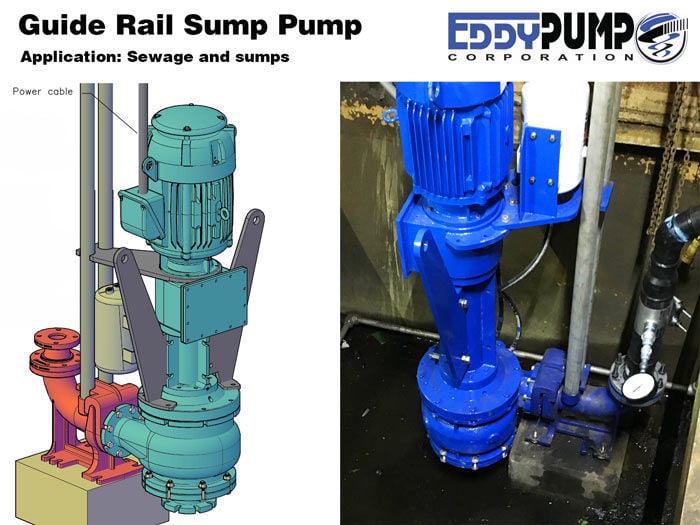
How EDDY Pumps Move High Solids and Sewage?
Our patented pump technology outperforms all centrifugal, vortex and positive displacement pumps in a variety of the most difficult sewage pumping applications. Our pump design allows for longer intervals between maintenance, which translates to increased output, more uptime and higher profits.
Some of the main types of pumps that may be used in wastewater treatment plants include:
- Centrifugal pumps: These pumps use centrifugal force to generate flow and pressure, which allows them to move liquids over long distances or against high pressures. They commonly transfer sewage and treated effluent in wastewater treatment plants.
- Diaphragm pumps: These pumps use a flexible diaphragm to move liquids and are typically used for transferring corrosive or abrasive fluids. They may be used in wastewater treatment plants to transfer chemicals, such as acids or bases, used in the treatment process.
- Peristaltic pumps use a flexible tube or hose squeezed by a roller or shoe, pushing the liquid through the pump. They are often used in wastewater treatment plants to transfer sensitive or fragile liquids, such as sludges or slurries, other types of pumps may damage that.
- Piston pumps use pistons or plungers to move liquids through a cylinder or hose. They are often used in wastewater treatment plants to transfer high-viscosity liquids, such as pastes or sludges.
- Screw pumps use a rotating screw or impeller to move liquids through a channel or pipe. They are often used in wastewater treatment plants to transfer thick or viscous fluids, such as slurries or pastes.
Call for sales or support
If you need assistance with pump selection, sales or engineering support, call 619-404-1916.


Dredge Project Consulting
- Easier to install and maintain, the horizontal slurry pump, a type of dredge pump, allows for quick access to pump components, making repair jobs straightforward. During repair jobs, pumps are completely disassembled for thorough inspection. All components are carefully inspected, and any parts not meeting standards are replaced. After reassembly, the pump is tested to ensure reliable performance. These steps help extend the service life of the hydraulic pump and maintain equipment reliability. EDDY Pump can also provide dredging project managers to oversee sediment projects and remediation projects, ensuring that all aspects of the dredging project are managed efficiently and in compliance with environmental regulations.
- Requires more room, due to its larger footprint compared to vertical
- Implementing best management practices and evaluating management alternatives are essential for effective material management in any dredging project.

Vertical Slurry Pump
-
Less smaller footprint, allowing the dredge pump to be implemented in hard to reach jobs
-
More versatile, can be cable hung straight down and inserted directly into medium to pump target material. The vertical slurry pump can also be used in mechanical dredging operations where minimal water addition is required.
-
The vertical slurry pump is typically situated within the excavator or dredging system so that it is optimally positioned for efficient material handling and performance.
-
More difficult to repair and tougher maintenance
Issues with pumps in wastewater treatment plants
Several potential issues may arise with pumps in wastewater treatment plants, which can affect the efficiency and reliability of the treatment process. Some of the main problems that may occur with pumps in wastewater treatment plants include the following:
- Clogging: Pumps in wastewater treatment plants may become clogged with solids or debris, reducing the flow rate and causing the pump to malfunction. Regular maintenance, such as cleaning and inspecting the pumps, can help prevent clogging.
- Corrosion: Wastewater treatment plants often use corrosive chemicals, such as acids or bases, which can cause deterioration of the pumps and other equipment. Regular maintenance and the use of corrosion-resistant materials can help prevent decay.
- Cavitation: Cavitation occurs when a pump’s impeller creates a vacuum that vaporizes the liquid being pumped, causing bubbles to form. When these bubbles collapse, they can create high-pressure shock waves that can damage the pump and reduce efficiency. Using a pump with the proper design and operating conditions can help prevent cavitation.
- Wear and tear: Pumps in wastewater treatment plants are subjected to high levels of wear and tear due to the abrasive and corrosive nature of the pumped fluids. Regular maintenance and replacing worn or damaged parts can help extend the life of the pumps.
- Electrical issues: Pumps in wastewater treatment plants may experience electrical problems, such as power surges or motor failures, which can cause the pump to malfunction. Regular maintenance and proper electrical protection can help prevent these issues.
Youtube not loading? Try our alternate video player
How The Pump Works
Why EDDY Pumps Are Better – Highlights
This video shows how EDDY Pump beats out traditional centrifugal pumps when it comes to tough slurry and abrasive materials. EDDY Pump is the at the heart of all of our featured dredge pump equipment including the Remote Operated Subdredge, Diver Operated Pump and a Excavator Attachment Dredge Pump.
The Best Non-Clog and High Solids Slurry Pump on the Market. Since 1984.
We manufacture both pump and dredge equipment for maximum compatibility


Call for sales or support
If you need assistance with pump selection, sales or engineering support, call 619-404-1916.
HD (Heavy Duty) Slurry Pumps / Dredge Equipment
Related Products
For assistance Call 619-404-1916 and let us help match your project
with the right pump.