
Home / Case Studies /
St. Clair River
Surgical Contaminated-Sediment Removal With a Custom Tornado II EDDY Pump Dredge
When toxic sediment had to come off 3,000 ft of shoreline without disturbing the soft clay beneath, Dow Chemical Canada turned to a custom-built Tornado II EDDY Pump dredge that removed 98–100% of the contaminated layer — 28,000 cubic yards across three phases — and pumped it 3,500 ft up a 70-ft rise to a holding pond.
ENVIRONMENTAL CASE STUDY
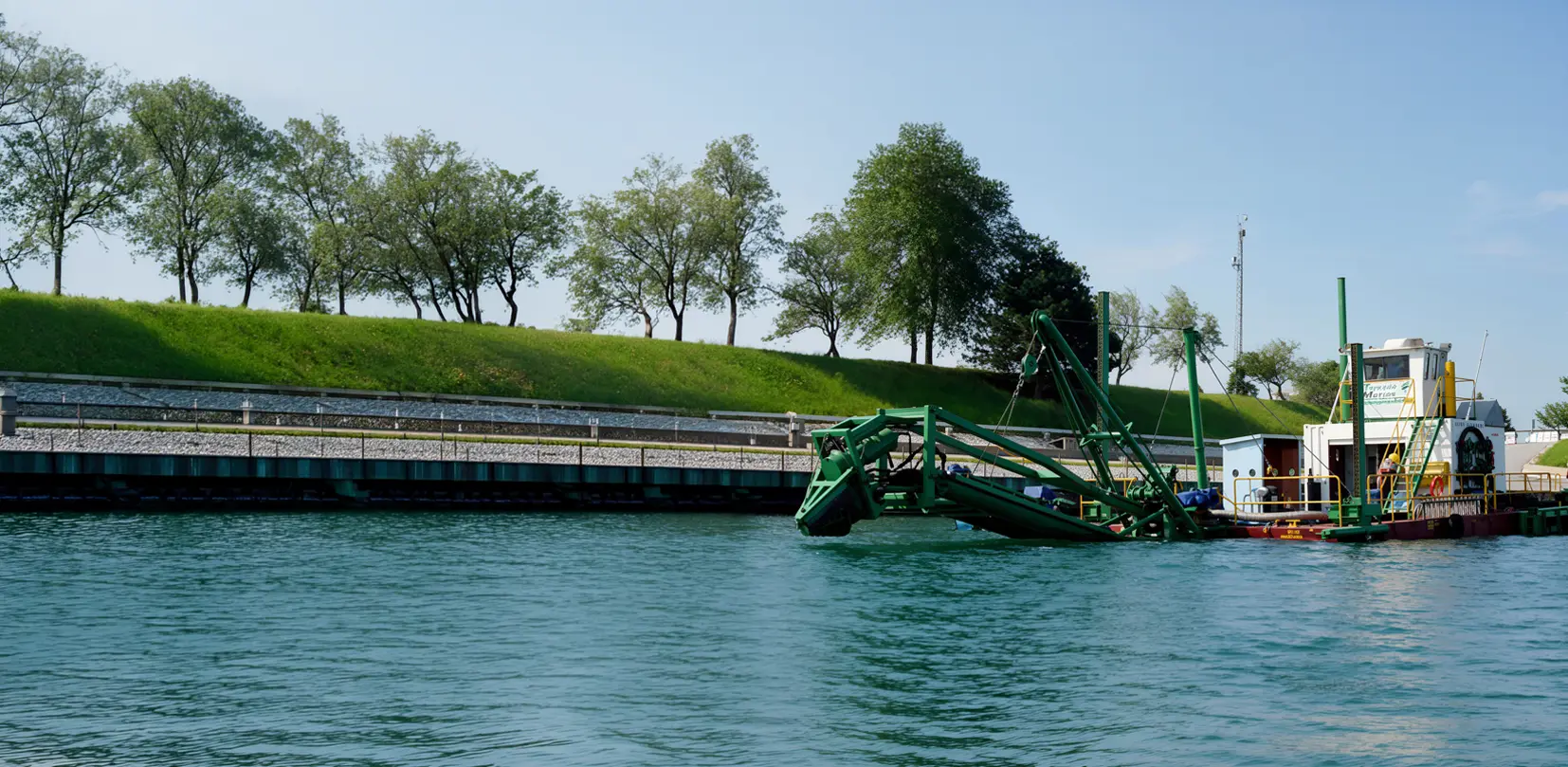
To clean up 3,000 feet of contaminated shoreline, Dow Chemical Canada turned to a custom EDDY Pump dredge that removed only the toxic layer — sparing the soft clay beneath.
Dow Chemical Canada decided to be proactive and clean up some 3,000 feet of its shoreline on the St. Clair River. Many technologies were analyzed and a few were tried, but with limited success. Dow then contracted URS Corporation to develop a solution — and URS brought the problem to EDDY Pump (TM Technologies), which engineered and built the custom equipment the job demanded: the Tornado II dredge.


OF THE DEPOSITIONAL SEDIMENT REMOVED
TOXIC MATERIAL REMOVED ACROSS THREE PHASES
PUMPED UP A 70-FT RISE TO THE HOLDING POND
The Challenge: Removing Toxic Sediment Without Disturbing the Clay Beneath It
The contaminated sediment lay across a very uneven underwater landscape, with slopes up to 45 degrees. The contaminant layers ranged from 3 inches to more than 9 feet deep, resting on top of soft, highly plastic clay — so the dredge had to run parallel to the shore and remove only the contaminated layer, without disturbing the clay substrate beneath.
The site had been documented since the 1950s. Across roughly 375,000 square feet, sediments held metals and chlorinated and free-phase organic chemicals — mercury, cadmium, lead, hexachlorobenzene (HCB), hexachlorobutadiene (HCBD), octachlorostyrene, carbon tetrachloride, and perchloroethylene — dumped from an outfall at the north end of the property. In places, the dredge faced cuts over 9 feet high and a 3–6 inch layer of calcium carbonate to punch through.
The Solution: A Custom-Built Tornado II EDDY Pump Dredge
- Custom-built Tornado II dredge on EDDY Pump’s patented pumping system
- Moves 30–70% solids while maintaining 1,900–2,000 gpm
- Pushes material through 3,500 ft of conveyance pipe and up a 70-ft rise to the holding pond
- Engineered to pump solids in 2–30 ft of water
- Articulated head surgically removes toxic sediment in and around confined spaces
- Adjusts to the river bottom’s changing contours, delivering a level cut that leaves only guard marks in the clay
98–100% of the depositional sediment removed — 28,000 cubic yards of toxic material across three phases — pumped 3,500 feet and up a 70-foot rise to a secure holding pond.
ST. CLAIR RIVER ENVIRONMENTAL CLEANUP · DOW CHEMICAL CANADA
How the Tornado II Removed Contaminated Layers Without Disturbing the Clay
At the core of the Tornado II is the patented EDDY Pump, not a centrifugal, positive-displacement, or vortex pump, but a geometrically designed spinning rotor that creates a synchronized eddy current, like a tornado. Because the rotor sits out of the flow stream, it moves high percentages of solids and passes debris that would clog conventional pumps.
That design gave the operators the suction control to remove contaminated sediment layer by layer, lifting 30–70% solids at 1,900–2,000 gpm through 3,500 feet of pipe and a 70-foot rise, while the articulated head followed the river-bottom contours and took only the toxic material.


The Results: 98–100% of Contaminated Sediment Removed Across Three Phases
- Removed 98–100% of the depositional sediment — 28,000 yd³ of toxic material across three phases (May 2002 to December 2004)
- Took only the contaminated layer, sparing the soft clay substrate beneath
- Captured free-phase chemicals such as perchloroethylene that buckets would have released downriver — routing them safely to the holding pond
- An OMOE-administered monitoring program — turbidity at the dredge head and 75 ft downstream, plus periodic sampling for chemical constituents and TSS — confirmed downstream drinking-water quality was protected
- Helped move the St. Clair River toward de-listing as a Great Lakes Area of Concern
About The St. Clair River Cleanup
The St. Clair River, on the Canada–U.S. border, was one of 42 Areas of Concern identified under a binational Great Lakes Remedial Action Plan. Dow Chemical Canada proactively cleaned up roughly 3,000 feet of its shoreline — about 375,000 sq ft of sediment contaminated with metals and chlorinated organics — in three phases between 2002 and 2004, under approvals from Environment Canada and the Ontario Ministry of the Environment.
About Eddy Pump Corporation
Founded in 1984, EDDY Pump Corporation delivers breakthrough technology and service to industries including the U.S. Navy, oil & gas, mining, wastewater, paper/pulp, dredging, fracking, and chemical. At its core is the patented EDDY Pump — not a centrifugal, vortex, or positive-displacement pump, but a geometrically designed spinning rotor that harnesses the power of a tornado into fluid dynamics, handling material once deemed impossible or cost-prohibitive.